
When it comes to bringing a film to life, the right setting isn’t just background — it’s part of the story. Every sweeping cityscape, secluded forest, and bustling street scene on screen exists thanks to the Locations Department. This team is essential not only for shaping a film’s visual identity but for keeping production moving safely and smoothly behind the scenes.
The Locations Department
Effective location management is essential to both the creative process and the logistics of physical production.
Commonly known as “Locations,” this department oversees all aspects of preparing and managing locations for filming, from scouting and securing sites to obtaining permits and insurance, and ensuring compliance with municipal and provincial regulations. Working closely with the production team, and with support from Production Assistants (PAs) and a dedicated crew, they also manage key on-the-ground logistics such as traffic control, road closures, community relations, and public safety, ensuring each location is both creatively aligned and operationally ready.
The Locations Department is the bridge between the creative needs of the production and municipal requirements, balancing artistic vision with real-world logistics. Their expertise ensures a film’s story unfolds in the best possible setting, while respecting the communities and spaces that make those moments possible.
Key Roles in the Locations Department
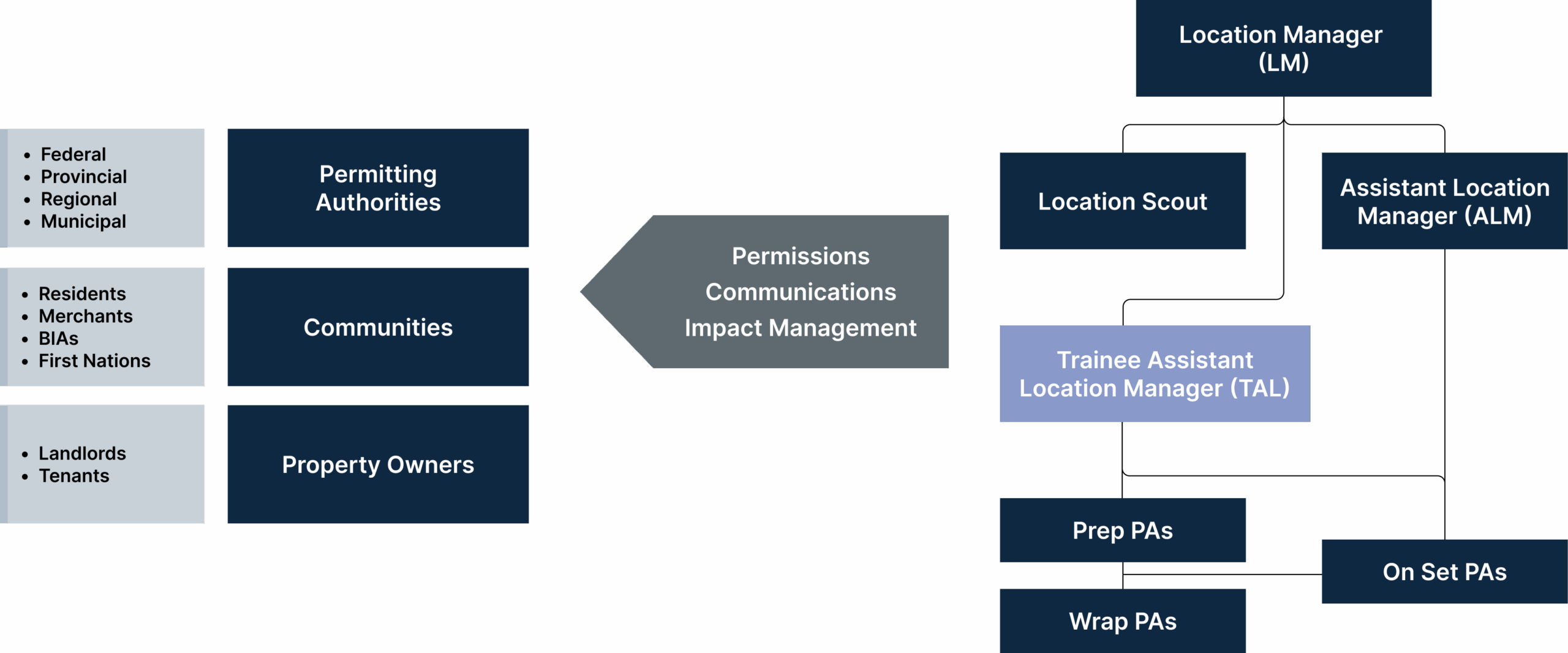
Location Manager (LM)
The Location Manager leads the Locations department, balancing creative vision with logistical execution.
- Collaborates with the Director, Production Designer, and Director of Photography to identify the tone, period, and look of locations for the story.
- Sources and presents vetted location options that fit both creative needs and production logistics.
- Manages the department budget, covering location fees, permits, parking, traffic management, and neighbourhood impact.
- Negotiates contracts and oversees the Locations team to ensure permits, community relations, and on-set logistics are handled smoothly and professionally.
Assistant Location Manager (ALM)
There can be multiple ALMs on a production depending on the production’s scope and budget. ALMs handle on-the-ground logistics and team coordination.
- Manage location prep, wrap, safety measures, parking, and traffic control.
- Act as an information hub for location-related needs.
- Oversee PAs and coordinate logistics for all departments.
- Serve as a bridge between production, permitting authorities, and the community.
Location Scout (Scout)
Scouts source and photograph potential filming locations, ensuring they meet creative and logistical needs.
- Present up-to-date location options to the creative team.
- Use personal libraries, BC Film Commission at Creative BC’s library, and scout new sites.
- Re-check known locations and flag potential permit or scheduling conflicts.
Trainee Assistant Location Manager (TAL)
Entry-level support focused on administration and prep tasks.
- Assist with contracts, insurance, permits, and payments.
- Help with location prep and wrap as directed by LM.
- Act as liaison between Locations, Accounting, and Production offices.
Production Assistant (PA)
- The number of PAs on set is determined by scope of film activity and location.
- Frontline support for location prep, public safety, and community engagement.
- Deliver notification letters and prep neighbourhoods.
- Monitor public safety and communicate with residents.
- Assist with setup and wrap for all departments.
Why It Matters
The Locations department gives every production a place to exist, inherently shaping its emotional tone and visual identity. From the first scout to the final wrap, this team turns scripts into living, breathing worlds. They navigate tight city streets, remote wilderness, and everything in between. With each project, Locations professionals ensure the perfect backdrop is in place, while keeping production safe, efficient, and respectful to the communities involved. Their work may happen behind the scenes, but its impact is front and center, transforming B.C.’s diverse landscapes into iconic cinematic worlds.