Working in film is more than lights, camera, action. It’s about collaboration, precision, and adaptability. Whether you’re dreaming of composing shots, scouting the perfect location, or designing VFX worlds, every role on a film set shares a common foundation: the essential skills that help productions run smoothly and people succeed. Even jobs that are film-adjacent (such as accounting, marketing and publicity, or legal support) require many of the same qualities. So, what exactly do you need to succeed?
A role for every skillset
There are countless jobs in the motion picture industry, from the creative decision-makers (above-the-line), the on-set crew who bring the production to life (below-the-line), to the digital experts handling creative tech, and the many adjacent roles that support this bustling industry. Learn more about these categories here.
Each role has its unique requirements, some more obvious than others. Of course, you need technical training to set up a light, operate sound recording equipment, or colour correct a shot. But soft skills are just as crucial. For example, a Script Supervisor needs sharp attention to detail and excellent note-taking abilities. A Location Manager requires exceptional organizational skills. And a Production Assistant, often the starting point for many film entrants, must be flexible, quick-thinking, and able to juggle multiple tasks. Despite these differences, all roles share a core set of transferable skills that can truly make the difference between just getting by and thriving on set.
The universal skills: what every role requires
No matter your pathway into the industry, whether through film school, on-the-job experience, or training programs like Setwork, you’ll need a mix of core competencies that apply across the board.
And let’s not forget: learn the language. The film industry has its own dictionary of terms, and understanding the lingo can help you feel more confident and credible from day one. Discover the Dictionary of Terms.
The top five skills for new entrants
Based on industry research conducted in B.C., these are the most important skills for those starting out in the motion picture industry:
Acting with honour & character. Showing up on time, being respectful, doing your job, and owning your mistakes earns trust. Reliability and a strong work ethic build trust on set.
Communicating effectively. Know how to take direction, speak clearly, and ask questions when you’re unsure. Good communication keeps the team aligned.
Keeping on point. Stay focused on your task, follow directions carefully, and avoid distractions.
Getting organized. Sets move fast. Staying on top of your responsibilities (and shifting gears quickly) is key. Be prepared, manage your time, and keep track of details.
Managing diverse relationships. Film is collaborative by nature. Your ability to listen, adapt, and work well with others is crucial. Respect, patience, and empathy go a long way in building strong working relationships.
These insights come from a 2019 Labour Market Study of B.C.’s below-the-line motion picture workforce, where hiring managers and crew members were asked what it really takes to succeed in the industry.
More transferrable skills to advance in the industry:
Punctuality. Showing up on time and sticking with the schedule is one of the simplest and most important ways to earn trust and keep productions on track.
Flexibility. Schedules shift. Locations change. You will need to act accordingly and with professionalism.
Situational awareness. Know what’s happening around you at all times. Sets are fast-paced and crew is always on the go. Avoid blocking equipment, stepping into shots, or creating hazards to keep everyone safe and the production flowing smoothly.
Managing stress and fatigue. Learn how to take care of yourself and work steadily through challenges. Knowing yourself and your needs is integral.
Initiative. Be proactive. If you see something that needs doing and it’s safe and appropriate to help, do it. But avoid stepping into someone else’s role.
Passion meets purpose
Getting into film takes grit, training, and the right connections, but staying in it takes something more: personal growth, adaptability, and a real commitment to working together. The film industry is a world where camaraderie and creativity thrive under pressure, and there’s nothing quite like the magic that happens when a crew comes together to bring a story to life. If you’re fuelled by curiosity, collaboration, and the excitement of building something from the ground up, film offers the kind of fulfillment that’s hard to find anywhere else.
When it comes to bringing a film to life, the right setting isn’t just background — it’s part of the story. Every sweeping cityscape, secluded forest, and bustling street scene on screen exists thanks to the Locations Department. This team is essential not only for shaping a film’s visual identity but for keeping production moving safely and smoothly behind the scenes.
The Locations Department
Effective location management is essential to both the creative process and the logistics of physical production.
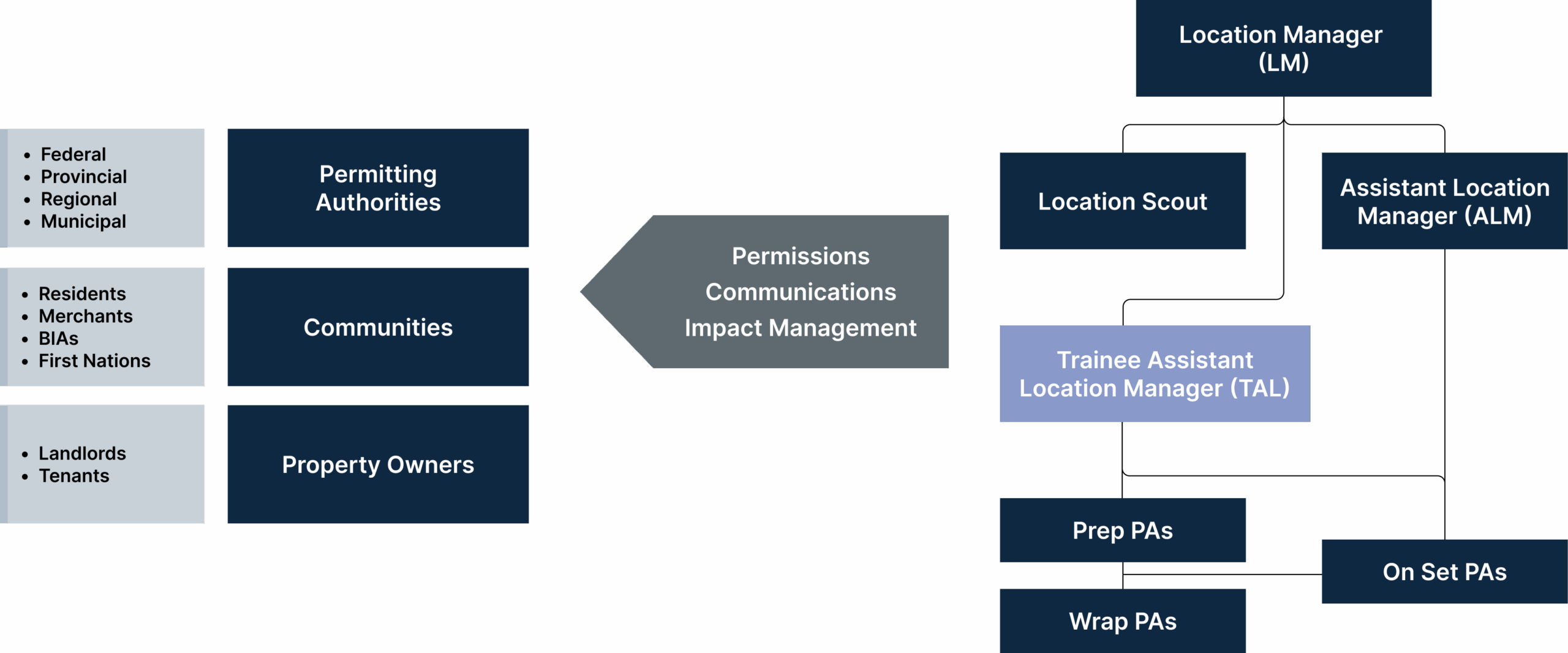
Commonly known as “Locations,” this department oversees all aspects of preparing and managing locations for filming, from scouting and securing sites to obtaining permits and insurance, and ensuring compliance with municipal and provincial regulations. Working closely with the production team, and with support from Production Assistants (PAs) and a dedicated crew, they also manage key on-the-ground logistics such as traffic control, road closures, community relations, and public safety, ensuring each location is both creatively aligned and operationally ready.
The Locations Department is the bridge between the creative needs of the production and municipal requirements, balancing artistic vision with real-world logistics. Their expertise ensures a film’s story unfolds in the best possible setting, while respecting the communities and spaces that make those moments possible.
Key Roles in the Locations Department
Location Manager (LM)
The Location Manager leads the Locations department, balancing creative vision with logistical execution.
Collaborates with the Director, Production Designer, and Director of Photography to identify the tone, period, and look of locations for the story.
Sources and presents vetted location options that fit both creative needs and production logistics.
Manages the department budget, covering location fees, permits, parking, traffic management, and neighbourhood impact.
Negotiates contracts and oversees the Locations team to ensure permits, community relations, and on-set logistics are handled smoothly and professionally.
Assistant Location Manager (ALM)
There can be multiple ALMs on a production depending on the production’s scope and budget. ALMs handle on-the-ground logistics and team coordination.
Manage location prep, wrap, safety measures, parking, and traffic control.
Act as an information hub for location-related needs.
Oversee PAs and coordinate logistics for all departments.
Serve as a bridge between production, permitting authorities, and the community.
Location Scout (Scout)
Scouts source and photograph potential filming locations, ensuring they meet creative and logistical needs.
Present up-to-date location options to the creative team.
Use personal libraries, BC Film Commission at Creative BC’s library, and scout new sites.
Re-check known locations and flag potential permit or scheduling conflicts.
Trainee Assistant Location Manager (TAL)
Entry-level support focused on administration and prep tasks.
Assist with contracts, insurance, permits, and payments.
Help with location prep and wrap as directed by LM.
Act as liaison between Locations, Accounting, and Production offices.
Production Assistant (PA)
The number of PAs on set is determined by scope of film activity and location.
Frontline support for location prep, public safety, and community engagement.
Deliver notification letters and prep neighbourhoods.
Monitor public safety and communicate with residents.
Assist with setup and wrap for all departments.
Why It Matters
The Locations department gives every production a place to exist, inherently shaping its emotional tone and visual identity. From the first scout to the final wrap, this team turns scripts into living, breathing worlds. They navigate tight city streets, remote wilderness, and everything in between. With each project, Locations professionals ensure the perfect backdrop is in place, while keeping production safe, efficient, and respectful to the communities involved. Their work may happen behind the scenes, but its impact is front and center, transforming B.C.’s diverse landscapes into iconic cinematic worlds.
Choosing to work in B.C.’s motion picture industry means joining one of the world’s premier centres for screen production. With cutting-edge infrastructure, dependable tax incentives, and a skilled, experienced workforce, B.C. is a global destination for film and television.If you’re passionate about storytelling, creativity, or visual arts, but unsure how to turn that into a career in #BCFilm, this guide is for you. Whether you’re a student, a career-changer, or just starting to explore the industry, Creative Pathways™can help you understand the different disciplines and begin your journey.
Four Main Pathways Into the Industry
Not all careers in film follow a straight line. Many roles are freelance, and experience often starts before formal education. Your entry point depends on your interests:
Creative leads → Interested in writing, directing, or producing? Explore above-the-line roles.
On-set crew → Love the action of set life? Look into below-the-line production roles.
Creative tech → More into animation, VFX, or post? Consider studio-based digital careers.
Industry support → Want to contribute without being on set? There are dozens of film-adjacent careers in business, education, and logistics.
Writers. Directors. Producers. These are the vision-setters—the ones who shape a project’s purpose, story, and emotional impact. Getting started often means doing it all: writing, shooting, and producing your own work. Many break in by building a body of projects rather than waiting for a big break. Formal education helps, but so does working with others. Think: short films, writing groups, and learning by doing.
There are 300+ roles on a film set—and every one is essential. From lighting and camera to costumes and set design, these professionals bring ideas to life. You don’t need film school to start, but you do need grit, training, and connections. Most crew begin with short gigs or “day calls” before joining a union. Production Assistants (PAs) are often the first step in. It’s hands-on, fast-paced, and full of opportunity.
Prefer studio over set? This is where imagination meets software. Animators, VFX artists, and post production specialists build and finish the visual worlds we see on screen. These roles demand creative skill and technical training. Portfolios speak louder than résumés—and B.C. is home to top schools and world-renowned studios.
Not all film careers happen on set. From legal to logistics, publicity to education, these roles power the industry from the sidelines—essential, strategic, and often overlooked. Whether you’re sourcing equipment, running a festival, teaching the next generation, or supporting productions through government and industry organizations, you’re part of the ecosystem that keeps B.C.’s screen sector thriving. These jobs often follow traditional hiring models and offer stability beyond project-based work. Many start by applying transferable skills—like budgeting, coordination, or communications—to film-specific contexts.
Get trained. Most production roles require entry-level safety and orientation courses like MPIO and WHMIS.
Build experience. Start with student films, short projects, or day calls to get on-set exposure.
Stay connected. Programs like Setwork can help you land those critical first jobs and meet peers.
Know your path. Whether you’re aiming for union crew work, creative tech, or producing your own films, Creative Pathways™ helps you map the journey.
No matter which path you’re considering, the right information can make all the difference. Creative Pathways™ provide curated resources to help you find opportunities, and connect with the B.C. film and TV talents.
We use cookies to ensure that we give you the best experience on our website. If you continue to use this site we will assume that you are happy with it.